


Honey, We Shrunk the Bets: Why We Are Trimming the Swings While Staying Invested
Financial Planning Investing News Risk ToleranceAt a Glance: Key Takeaways
- Maintaining our pro-risk tilt: We are keeping a 1% equity overweight across our target models. The macroeconomic backdrop remains constructive, anchored by remarkable corporate earnings growth.
- Profits are outrunning prices: S&P 500 forward earnings-per-share estimates are up 30.1% year-to-date, while stock prices have risen 11.4%. That has compressed price-to-earnings valuations by 13.5%, giving this bull market solid fundamental grounding.
- Exiting standalone momentum: Following sharp summer rotations and factor whiplash, we eliminated our dedicated momentum ETF to harvest gains, lower active volatility, and reduce single-factor concentration.
- Refining our AI and defense positions: We trimmed high-volatility core AI and global defense holdings to take profits after exceptional runs. We remain long-term believers in AI enterprise adoption and are focusing on high-quality US large caps putting AI to productive work.
- Neutralizing broad regional tilts: We shifted our broad US vs. international equity stance to neutral. Rather than making sweeping geographic bets, we are utilizing our active international country rotation strategy to target dispersion between individual nations.
- Upgrading fixed income and alternatives: We maintain a modest underweight to duration. We are broadening the bond sleeve by introducing active mortgage-backed securities, adding global sovereign bonds, and leaning into liquid alternatives and gold as non-correlated shock absorbers.
At Wrought Financial Planning, we do not believe in a "set it and forget it" approach to managing wealth. Economies evolve, market regimes shift, and your portfolio must adapt dynamically to protect and grow your capital.
Last week, we executed a tactical rebalance across our client portfolios. These adjustments reflect our continuous macroeconomic analysis, proprietary stress-testing, and ongoing risk budgeting.
If you had to summarize this rebalance in a single phrase, it would be: "Honey, we shrunk the bets."
We are not retreating from markets. We remain bashful bulls, but do not call us bearish. The underlying economy remains resilient, and we want our clients participating in growth. However, after substantial market gains and sharp summer rotations, doing nothing is an active risk.
This rebalance is about keeping our high-conviction ideas while trimming the magnitude of the swings. Here is what we changed and why.
1. Profits Are Outrunning Prices: The Foundation of the Rally
Headlines this year have been noisy. Investors have had to digest geopolitical flare-ups in the Middle East, volatile commodity prices, and mixed signals from the Federal Reserve.
Yet underneath the surface, corporate earnings have delivered a powerhouse performance. S&P 500 forward earnings expectations have jumped 30.1% year-to-date. Over that same period, the S&P 500 price index has gained approximately 11.4%.
Because earnings have grown nearly three times faster than share prices, market valuation multiples have actually contracted by 13.5% this year.
Profits are outrunning prices: Change in S&P 500 earnings vs. price vs. valuation YTD
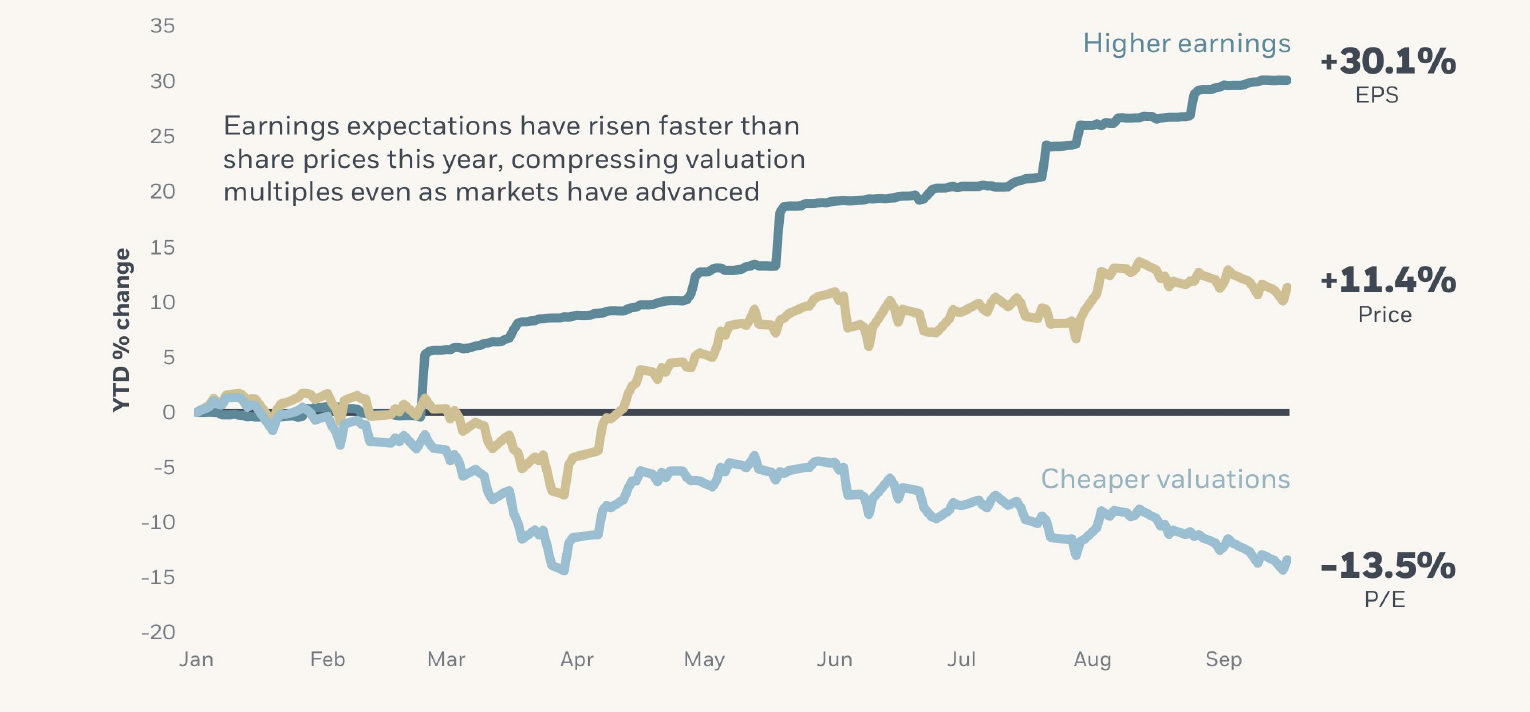
Our Take: In the late 1990s dot-com bubble, prices skyrocketed on hopes, dreams, and zero earnings. Today, the opposite is happening. Stock prices are climbing, yet valuations are getting cheaper because corporate profits are expanding so rapidly. Even the median S&P 500 company is projecting 12% earnings growth.
This earnings cushion provides equities with substantial room to absorb policy rate adjustments from the Fed or short-term economic bumps. That fundamental strength justifies keeping our foot on the gas with a 1% equity overweight.
2. Taming the Whiplash: Exiting Momentum and Right-Sizing AI
When certain themes run hard, they can quietly hijack a portfolio. A position that started as a modest tilt can swell into an unintended concentration risk.
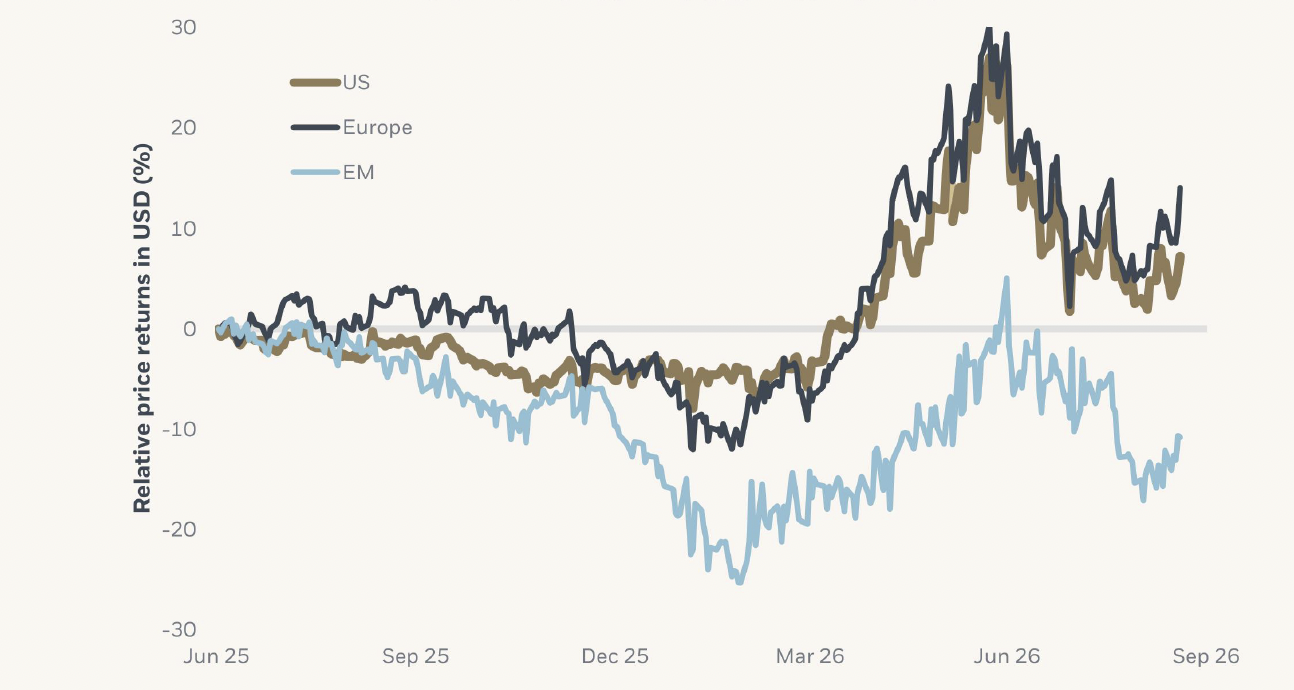
Over the summer, markets experienced sharp rotations. Yesterday's high-flying winners suddenly reversed course, creating significant whiplash in momentum-driven strategies. Additionally, upcoming index reconstitutions threatened to reshuffle underlying factor baskets in ways that no longer matched our targeted risk profile.
Momentum's summer whiplash shows how quickly yesterday's winners can reshuffle
To rein in these factor swings, we made three deliberate pruning decisions:
- Exited standalone momentum: We closed out our dedicated momentum ETF. We captured substantial gains from the trade, and eliminating it immediately lowers active tracking error and portfolio volatility.
- Trimmed core AI tech: We remain thoroughly invested in the artificial intelligence theme. However, price volatility in pure-play AI innovation funds increased substantially over the summer. We trimmed the position to align with our volatility budget while adding to core US large-cap active strategies that target established companies successfully monetizing AI.
- Pruned global defense: We initiated our aerospace and defense thesis earlier this cycle, and it has performed admirably. Defense budgets continue to expand globally, but we believe in taking gains off the table rather than letting positions run unchecked.
Our Take: Trimming winners is not an admission of defeat. It is how disciplined investors protect capital. By dialing back single-factor exposure and taking profits in high-beta themes, we keep portfolio risk where it belongs: intentional, measured, and diversified.
3. Broadening the Playbook: Neutralizing Regions, Targeting Countries
Over the past year, our portfolios maintained a distinct overweight to US equities over international developed markets. That positioning was profitable.
However, recent corporate earnings reports and analyst revisions have narrowed the performance gap between the US and the rest of the world. International markets, particularly European and emerging market exporters, have posted impressive earnings growth.
Broader profits, broader playbook: Drivers of 12-month stock market returns by region
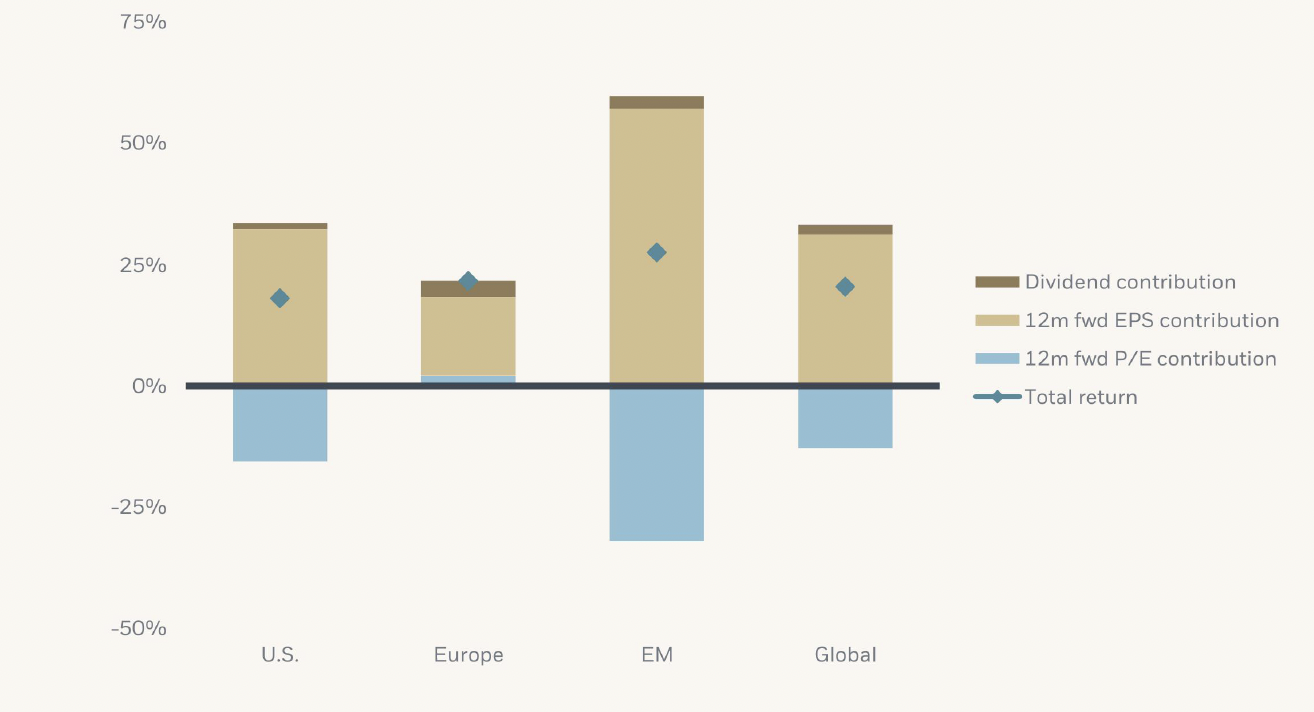
Rather than keeping a heavy macro tilt toward the US, we reset our broad regional equity allocation back to neutral.
At the same time, return dispersion between individual countries within Europe, Asia, and Latin America has expanded significantly. To exploit this dispersion, we increased our allocation to our actively managed international country rotation strategy.
Our Take: Broad geographic buckets like "international stocks" can mask massive differences between winning and struggling nations. Moving to a neutral regional baseline while employing active country selection gives us surgical precision. We can participate in overseas strength without taking on uncompensated macro baggage.
4. Upgrading the Shock Absorbers: Active Mortgages, Global Sovereigns, and Real Assets
Fixed income continues to face a complex environment. The Federal Reserve is navigating volatile energy prices and persistent services inflation. Treasury yields have drifted higher, with the 10-year Treasury yield repeatedly testing the 5% threshold.
In this environment, relying solely on traditional corporate bonds or benchmark duration can leave portfolios vulnerable. Corporate credit spreads remain near historical lows, meaning investors are barely compensated for taking default risk. To use a driving analogy: we want our brakes to work when we actually need them.
Portfolios at a glance: Tactical positioning across asset classes
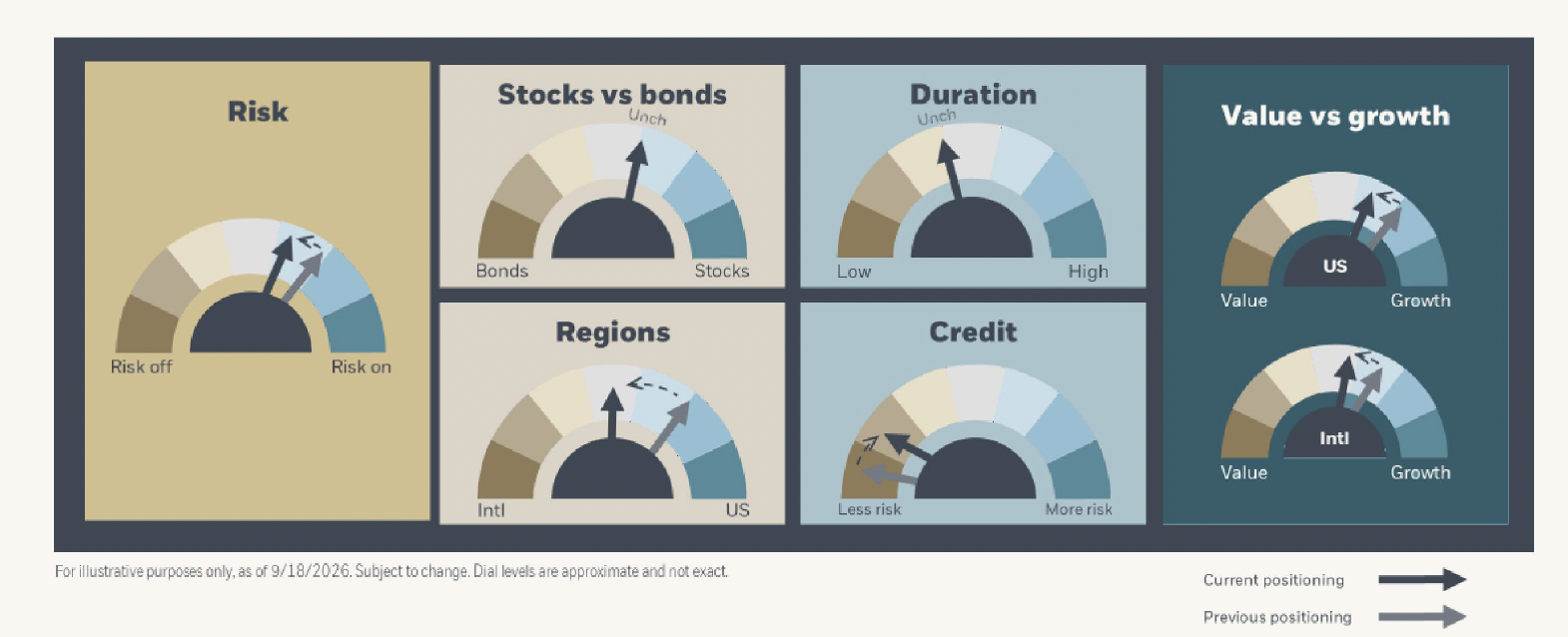
To build a more resilient defensive engine, we made several structural refinements to our bond and alternatives sleeves:
- Active mortgage-backed securities (MBS): We shifted mortgage exposure from passive index tracking into an actively managed mortgage strategy. This allows skilled credit managers to exploit prepayment shifts and pricing anomalies with minimal active risk.
- Global government bonds: We added currency-hedged global sovereign bonds, diversifying our interest rate exposure away from complete reliance on US fiscal dynamics.
- Multi-strategy liquid alternatives and gold: We maintained and modestly increased our allocations to non-traditional assets. Liquid alternatives use long-short strategies that can generate positive returns regardless of whether markets rise or fall. Gold continues to provide a dependable store of value against geopolitical friction and currency fluctuations.
Our Take: Upgrading bond quality, keeping duration slightly shorter than the benchmark, and incorporating non-correlated alternative assets ensures your portfolio has genuine shock absorbers if the equity market hits turbulence.
The Bottom Line: Built for Life, Not Just for Bull Markets
Tactical rebalancing is not about guessing which way the market will jump tomorrow. It is about systematically aligning your capital with empirical reality.
When profits surge, we recognize the strength. When position sizes get bloated or factor volatility accelerates, we trim the excess and reallocate to assets that offer better risk-adjusted value.
At Wrought Financial Planning, our mission is to manage the complexities of your balance sheet so you can focus on what matters most: your family, your career, and living a life of true optionality. Money is simply a tool to buy back your time.
If you are an entrepreneur, partner, or self-employed professional wondering whether your current portfolio is built to handle today's market regime, we welcome the opportunity to connect.
Schedule Your Free Consultation Today!